Additional Thoughts About Murderbot

Note: This was originally posted along with my review of “Artificial Condition”, before I decided to move it to a separate post.

As much as I’ve enjoyed the first two books in “The Murderbot Diaries” by Martha Wells I have to say I have mixed feelings with the way intelligence is talked about in these books. Murderbot thinks of itself as superior to all other AIs because it hacked its governor unit and is no longer being controlled by the company. It also thinks itself superior to all humans. It has a lot to say about the intelligence of everyone – AI and human alike. Sometimes going as far as making judgements about the usefulness of those who are less intelligent. Since the books are from Murderbot’s POV the bias can be interpreted as bias on the character’s part more than the narrative suggesting it but it was something I noticed.

I also made note of how humans a categorized as human and augmented humans and it’s not clear who is augmented. Can anyone be augmented or are most of them previously disabled humans who need assistive tech like hearing aids or glasses? If most of them are in fact disabled humans then there’s some negative implications about the distinction. Though again it’s Murderbot’s POV and if it categorizes people that way because it feels closer to augmented humans than humans that’s different.

I do feel the way Murderbot feels superior to everyone and free to call everyone unintelligent (the word stupid is used a lot) is a problem. The idea that one is better than someone else just because they’re smarter is not the greatest idea to hold. It’s the root of eugenics and the reason people with intellectual disabilities are treated badly by everyone including people with physical disabilities who often try to distance themselves from the idea they may be unintelligent. “I may be physically disabled buy my brain is fine” ableism is rampant. People with varying degrees of intellectual disabilities have been categorized in the past with their level of usefulness for jobs and I see hints of that in how Murderbot talks about the various AIs it has worked with in the past and encounters on its journey. The idea of dumb vs smart technology may be a thing that is common in Science Fiction and talking about AIs but we should all be aware of where it comes from and what it means when applied to people.

It’s true the humans Murderbot encounters are putting themselves at risk and making choices that would have gotten them killed if not for Murderbot being there to protect them. But is that really a lack of intelligence? Are they really stupid or merely young and inexperienced with how bad things can be? Should they “know better” or have they not yet had the opportunity to learn because they are young? Even for those who should “know better” the choice is still theirs to make. We may think those choices are wrong but if they know the risks and make them anyway are they really “stupid” or just reckless with their lives? While it’s true people use “stupid” as a short cut for a lot of flaws, that is in fact the problem. We make these kinds of judgements all the time and feel superior because we apparently smarter than those who make “poor choices” but I’m sure somewhere along the line we go out and make a choice someone else would question us about.

Previously I wrote an essay called “The Problem of Intellectual Ableism” that I think is relevant to this post. Give it a read. I don’t believe the problems I see in this book are entirely intentional, and I don’t have anything against the author for any of this. The issues I see in the Murderbot Diaries are present everywhere to varying degrees as they are systemic issues. People often use intelligence based insults whenever they judge others – which is the whole problem. These books just seemed to emphasis that a lot because of Murderbots superiority complex. At least in this book Muderbot learns that it can be wrong in its assumptions – it originally assumes ART is a “dumb bot” before it learns better. Still… the assumptions were made, as they often are about intelligence and worth.

How we talk about disability

Note: Originally posted on https://jenrohrigdesign.com/

The way we talk about disability matters but the complicating factor is that different people and different groups have different preferences. People with intellectual disabilities tend to prefer person first language and the concept of “see ability not disability”. This is because of the long history of being dismissed and looked down on by everyone including those with physical disabilities. If you’ve ever used the phrase “I may have a physical disability but my brain is fine” you’ve contributed to. On the flip side people with physical disabilities and some developmental disabilities (like autism) tend to prefer identity first language and usually (but not always) don’t find the use of the word disabled offensive. Some don’t like to use the word disabled but instead prefer to only use the name of their identity – Deaf or Autistic for example. None of this is 100% true all of the time but in general it’s a good baseline to understand.

When we talk about accommodating disabilities there is often a focus on the deficits that the accommodations are helping with. This individual can’t hear so they need closed captions or ASL interpreters; this individual can’t walk to they need a wheelchair; and so on. This is especially true in education settings for children who have IEPs. Because of the way school systems focus on their budgets they tend to focus on how much something will cost. This results in parents having to fight to get the accommodations their child needs by emphasizing their disabilities in order to prove that the need exists, instead of being able to focus on how the accommodations would help them succeed in school. This battle often repeats each year because school administrations will want to take away accommodations if they see an improvement. The argument the school will use is that the child has improved so the accommodation obviously isn’t needed anymore, ignoring that the child is doing better with the accommodations and taking them away would mean not doing as well.

Because there is such an emphasis on deficits in education there ends up being a push for “seeing abilities not disabilities”. It becomes especially true for people with intellectual and developmental disabilities as they fall behind their peers in school. Sometimes this is the case before they even start school when doctors tell parents that their children won’t amount to much because of their disabilities. So naturally organizations like Special Olympics will focus on proving what people with intellectual disabilities are capable of doing rather than what they can’t. Special Olympics is of course focused on sports so there is an emphasis that sports don’t see disability. There’s nothing really wrong with this thinking in a general sense. It is important to see that a person can be capable of things and not make assumptions based on their disabilities. That’s why people act so amazed when a person with Down Syndrome completes a Marathon. There’s an assumption that they can’t possibly run a marathon, when the truth is they often can with enough training and enough support just like anyone else.

Of course limitations will always exist (even without disabilities in the mix). The key is not allowing other people to enforce false limitations on a person, but also acknowledging the real limitations that exist. Because, ignoring a disability completely will cause harm if not acknowledged. It’s also a problem when people say “if this person with a disability can do this why can’t you?” ignoring that everyone’s abilities actually are different. That’s why my preference is to see the disability along with the ability. I’m still hard of hearing regardless of having a hearing aid. My hearing is not 100% – there will still be times I don’t hear something and people will need to repeat themselves. I also still need closed captions to watch videos or TV shows – the sound is not clear enough to hear everything and there is usually background noise. So yes I still need people to “see my disability, not just my abilities”. But I do think we can change how we talk about our disabilities so that it’s not always about the deficit. Just saying I need people to repeat themselves or captions should be enough without having to explain that I am hard of hearing. There shouldn’t be a reason to have to prove anything. Access needs should be understood and accepted across the board.

Additional Reading

“I Shouldn’t Have to Dehumanize My Son to Get Him Support: Instead of focusing on the challenges facing disabled people, we should emphasize goals.” – by David M Perry at “The Nation”

“The Problem of Intellectual Ableism” posted by me on this blog.

“About Limits” posted by me on this blog.

“Season One: Iris and the Crew Tear Through Space!” Review

“Season One: Iris and the Crew Tear Through Space!” by Cait Gordon

In a galactic network known as the Keangal, where space is accessible.

Lieutenant Eileen Iris and the command crew of the S.S. SpoonZ haven’t a clue what it means to be disabled. An unexpected conversation with an intergalactic janitor brings up the question but offers no answers before he’s ‘ported away.

Unfazed, duties resume as Iris manages an overprotective guidebot; Security Chief Lartha and her sentient prostheses offer kick-ass protection; Mr. Herbert’s inventiveness is a godsend (although he’s not quite grasped how to flirt); Commander Davan’s affable personality comes through whether trumpeted, texted, or signed; and Captain Warq’s gracious but firm leadership keeps everyone at their best.

Until on one mission, where the crew tears through space.

Just a little bit.

Review

I really enjoyed the characters, (which included both disability and LGBQIA+ representation), and the various adventures they all had. I thought showing how well they all worked together worked for the book and it’s a great concept. Here’s the thing – I would have enjoyed this more if the first chapter hadn’t contained the scene mentioned in the description where the intergalactic janitor calls the crew disabled and the crew has no idea what it means.

I understand the intent behind the book with all access needs being taken care of and everything is just fine – similar to the Star Trek: The Next Generation universe where everything is taken care of (with some exceptions once you look beyond the Enterprise). But I also felt like the author wanted to have it both ways. Never mentioning disability, just accessibility needs but there are still moments in the book where needs aren’t always met completely or in a way that works for everyone. Also there was a sub-plot about one character who was not sensitive to diverse body-minds and had to be made to be more aware of his behavior.

Now it could also be said that the reason “disability” is never mentioned is that several, if not all, of the crew members are actually aliens who have different access needs that present as real world disabilities (autistic, d/Deaf, vision issues, non-speaking with mouth words, etc). Which would be the actual reason why disability is never brought up because they’re not disabled in a way that we’d call it. But other terminology related to disability is used the same way we would use it, accessibility, wheelchairs, guide bots (as apposed to guide dogs) and so on. While you may be able to talk about various access needs without using the word disabled it makes it awkward to read about as a disabled person.

Also everything is ideal for the crew but no mention is made of anyone with higher support needs or intellectual disabilities. How are they taken care of in this universe? Are they helped or is all of this access for only the elite? It’s implied at one point that healthcare is paid (for some at least) but there are gaps in the world building that lead to more questions.

I honestly fee torn about this review, because I think without the “but you’re disabled” scene at the beginning I would have been focusing on the characters and the plot which are very good. In many ways the book does what the author appears to want to do with regard to showcasing how things could be. Unfortunately, for me the scene in the beginning brought up all the various questions about how the universe works. How did they get where they are without needing to use the word disabled? I also do wonder if I’m being hyper critical because I’m disabled too and have certain ideas about what we need to be saying about disability seem to be different from the author’s ideas.

Warnings and additional reviews are available on the StoryGraph page for “Season One: Iris and the Crew Tear Through Space!”.

Book Details

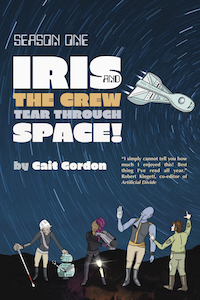
The cover has a group of four individuals standing on a rocky surface under a field of spinning stars that are circling above them. There's a spaceship in the upper right area. The four individuals include a person using a cane for the blind with a small robot at their feet they have their hand on the bot. Next is a person holding a large gun with at least one prosthetic leg visible. Next is a blue alien with a large trunk and he has his hand raised as if he's waving. Last is another individual with his hand on the alien character pointing up towards the ship.

Author’s Website
Cait Gordon
Publisher / Date
Renaissance Press, September 2023
Genre
Science Fiction
Page Count
302
Completion Date
August 4, 2024

“The Spirit Bares Its Teeth” Review

“The Spirit Bares Its Teeth” by Andrew Joseph White

London, 1883. The Veil between the living and dead has thinned. Violet-eyed mediums commune with spirits under the watchful eye of the Royal Speaker Society, and sixteen-year-old Silas Bell would rather rip out his violet eyes than become an obedient Speaker wife. According to Mother, he’ll be married by the end of the year. It doesn’t matter that he’s needed a decade of tutors to hide his autism; that he practices surgery on slaughtered pigs; that he is a boy, not the girl the world insists on seeing.

After a failed attempt to escape an arranged marriage, Silas is diagnosed with Veil sickness—a mysterious disease sending violet-eyed women into madness—and shipped away to Braxton’s Sanitorium and Finishing School. The facility is cold, the instructors merciless, and the students either bloom into eligible wives or disappear. So when the ghosts of missing students start begging Silas for help, he decides to reach into Braxton’s innards and expose its rotten guts to the world—as long as the school doesn’t break him first.

Review

This was such a good book with a lot of great characters besides Silas. While it doesn’t have quite as much gore as the other’s other book, there is some, all with a medical focus this time. I really enjoyed how Silas struggles to work everything out while dealing with everything else going on for him. The plot is very dark and disturbing but I really like how everything plays out. Certain things were not a surprise while others completely were and I really enjoyed it all. And I was really glad a particular plot point was resolved the way it did. The ending is a bit open ended but I think it makes sense given the storyline.

Be sure to take note of the authors warnings at the beginning of the book. Also be sure to read the authors end notes because while this story is fantasy the ugly truth is people always been sent a way because they were deemed unfit by society and many have been experimented on throughout history.

Warnings and additional reviews are available on the StoryGraph page for “The Spirit Bares Its Teeth”.

Book Details

The cover has a young person standing in the middle of it facing forwards but with their head turned to the right. Their skin is very pale white with brown hair and they are wearing a purple dress and holding a broken shard of glass that is also purple. Behind them is a sky in purple with white clouds. They're framed in an oval shaped image with other images of violet eyes all around the cover. The authors name is at the top and the title is at the bottom on a ribbon that is wrapped around the picture frame.

Author’s Website
Andrew Joseph White
Publisher / Date
Peachtree Publishing Company, September 2023
Genre
Historical Fiction, Horror, Young Adult
Page Count
381
Completion Date
July 21, 2024

“Loka” Review

“Loka” (The Alloy Era No. 2) by S. B. Divya

Akshaya is the hybrid daughter of a human mother and an alloy, a genetically engineered posthuman―and she’s the future of life on the planet Meru. But not if the determined Akshaya can help it. Before choosing where her future lies, she wants to circumnavigate the most historic orb in the universe―the birthplace of humanity: Earth.

Akshaya’s parents reluctantly agree to her anthropological challenge―one with no assistance from alloy devices, transport, or wary alloys themselves who manage humanity and the regions of Earth called Loka. It’s just Akshaya; her equally bold best friend, Somya; and a carefully planned itinerary threading continent by continent across a wondrous terrain of things she’s never seen: blue skies, sunrises, snowcapped mountains, and roiling oceans.

As the adventure unfolds, the travelers discover love and new friendships, but they also learn the risks of a planet that’s not entirely welcoming. On this trek―rapturous, dangerous, and life-changing―Akshaya will discover what human existence really means.

Review

This was a great book. It was a very quick read and I enjoyed reading Akshaya and Somya’s adventure around the world. Akshaya is a very typical teenager who wants to be able to make her own choices about everything and not feel forced to conform to what her mother wants for her. Both she and her mother have a lot to learn and do so throughout the course of the book. I really enjoyed the additional aspects of how disability was used. Like her mother Akshaya has sickle cell anemia and must figure out how to work with it on Earth where it’s more disabling than it would be on Meru due to different conditions. The entire story is about self discovery and figuring out where you belong in the universe.

While this book is a sequel to the previous book “Meru” – Akshaya’s parents are two of the main characters from that book – “Loka” works well enough as a standalone novel. I think anyone could read it without having read the first book. Though some plot points might be helpful to know for additional context.

Thank you to NetGalley, 47North and S.B. Divya for access to the ARC in exchange for an honest review.

Warnings and additional reviews are available on the StoryGraph page for “Loka”.

Book Details

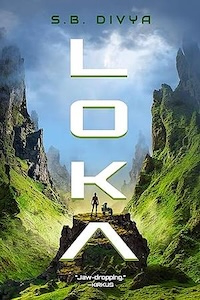
The cover shows a person and a small machine that looks somewhat like a dog in a valley between cliff sides with large patches of green up the sides. The two figures are in the distance standing on a rock looking upwards at the blue sky visible outside of the valley.  The book title is written from top to bottom one letter at a time and the author's name is at the very top.

Author’s Website
S. B. Divya
Publisher / Date
47North, August 2024
Genre
Science Fiction
Page Count
367

Completion Date
June 4, 2024

“Tell Me How It Ends” Review

“Tell Me How It Ends” by Quinton Li

Iris Galacia’s tarot cards do more than entertain gamblers. With the flip of her fingers she can predict the future and uncover a person’s secrets. But under the watchful eye of her mother, she is on thin ice for pursuing a passion in the family business, and then cracks start to form until she eventually she falls through. She is given an ultimatum — a test to prove her worth: earn a thousand coins or leave the business, and the family.

Enter Marin Boudreau, a charming young person who can scale buildings and break off door knobs, who comes for her help to rescue a witch who’s been falsely imprisoned in Excava Kingdom. And Marin is willing to pay a high sum for her talents. But saving a prisoner from royal hands isn’t easy, nor is leaving home for the first time in eighteen years.

Now Iris must learn to trust in herself, Marin, and this new magical world, while racing the clock before the royals decide the fate of the witch, and before any secrets catch up to her.

Review

I’m honestly not sure how I feel about this book because a lot of my issues with it can be explained by it being both a “cozy fantasy” and young adult. I did enjoy some things about it – the characters were interesting and all that. However, conflicts that should have been more serious are resolved almost instantly and with more compassion (from villains) than seems reasonable for anyone. Even the ending of the story with Iris making a choice about what to do next was too easy. Without spoiling too much, Marin never really proves themselves to be trust worthy and Iris feels too sheltered and naive to really be reliable in picking what she should do next. There’s a lot of reasons why she should escape her current life but it doesn’t feel like the found family she found is all that safe either. That said – how I feel about the ending of the book might be more about my personality (and age), along with the genres, than the story itself. One thing I did like was the way the Tarot cards were used in the story – there were a lot of good details about how they worked and how they helped Iris figure out what to do next. Not a series I’ll continue, but honestly if you like cozy fantasy with found family where things are resolved easily it might be more your cup of tea than mine.

Warnings and additional reviews are available on the StoryGraph page for “Tell Me How It Ends”.

Book Details

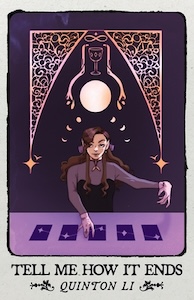
The book cover is a drawing of a person sitting behind a table with a set of 5 tarot cards that are face up on the table. Everything is various shades of purple.

Author’s Website
Quinton Li
Publisher /Date
Quinton Li Editorial, April 2023

Genre
Fantasy, Young Adult
Page Count
326
Completion Date
April 7, 2024

“The Infinite” Review

“The Infinite” (The Outside No. 3) by Ada Hoffmann

Time is running out for the planet Jai. The artificially intelligent Gods who rule the galaxy have withdrawn their protection from the chaos-ravaged world, just as their most ancient enemy closes in. For Yasira Shien, who has devoted herself to the fragile planet’s nascent rebellion, it’s time to do or die – and the odds are overwhelming. Enter Dr. Evianna Talirr. Talirr, the visionary who decimated the planet and began its rebellion, is not a woman to be trusted. But she’s returned with an unsettling prophecy: the only way to save Jai is for Yasira to die. Yasira knows it can’t be that simple. But as she frantically searches for other options, what she finds will upend everything she knew about the Gods, the galaxy she lives in, and herself.

Review

This was a great conclusion to the trilogy. I enjoyed reading how everything ending. I liked the way the story was formatted as a method to explain some of what had been happening in the past to lead to the current issues. That was a good way of doing things. There were a couple interesting plot twists along the way that made things more interesting as things developed. The ending felt realistic for all that had happened and how things were going. All and all a great series.

Warnings and additional reviews are available on the StoryGraph page for “The Infinite”.

Book Details

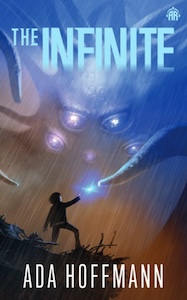
The cover is mostly blue and orange and has the figure of a person in dark clothing standing on a ledge pointing at a tentacle that is reaching out - there is light between them. Above is the body or head of a creature with serial eyes and more tentacles around the head.

Author’s Website
Ada Hoffmann
Publisher / Date
Angry Robot, January 2023
Genre
Science Fiction
Page Count
400
Completion Date
March 6, 2024

“The Fallen” Review

“The Fallen” (The Outside No. 2) by Ada Hoffmann

The laws of physics acting on the planet of Jai have been forever upended; its surface completely altered, and its inhabitants permanently changed, causing chaos. Fearing heresy, the artificially intelligent Gods that once ruled the galaxy became the planet’s jailers.

Tiv Hunt, who once trusted these Gods completely, spends her days helping the last remaining survivors of Jai. Everyone is fighting for their freedom and they call out for drastic action from their saviour, Tiv’s girlfriend Yasira. But Yasira has become deeply ill, debilitated by her Outside exposure, and is barely able to breathe, let alone lead a revolution.

Hunted by the Gods and Akavi, the disgraced angel, Yasira and Tiv must delve further than ever before into the maddening mysteries of their fractured planet in order to save – or perhaps even destroy – their fading world.

Review

This was a fun and interesting sequel to “The Outside”. It sort of has the usual problem of being the middle of a trilogy so things can’t be completely resolved but it also does a good job of setting up where everyone is at and the conclusion that is coming. I really liked that Tiv took the main point of view in this story as she struggles to deal with everything and help Yasira. Their relationship in the book is great. Yasira is struggling to deal with a lot of changes and Tiv continues to be by her side as much as she can. I think some might get a little frustrated with Yadira’s attitude but it really made sense for all that had gone on and the complete change to her reality. The other characters in the book are great and I liked that we got to see more characters and how they are involved with everything going on. I’m looking forward to reading the last book in the series.

Warnings and additional reviews are available on the StoryGraph page for “The Fallen”.

Book Details

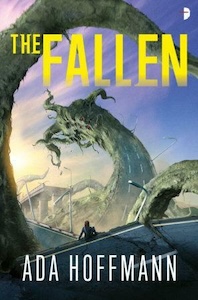
A person is sitting on a road that is broken in pieces and looking into the distance. Around and above them large structures can be seen as if the road was picked up and twisted into air with green branches coming off in various angles. A yellow sun is visible at the middle left side of the page and the sky is purple and blue.

Author’s Website
Ada Hoffmann
Publisher / Date
Angry Robot, July 2021
Genre
Science Fiction
Page Count
258 pages (some places say 368 but the digital version has less)
Completion Date
February 17, 2024

“Against Technoableism” Review

“Against Technoableism: Rethinking Who Needs Improvement” by Ashley Shew

When bioethicist and professor Ashley Shew became a self-described “hard-of-hearing chemobrained amputee with Crohn’s disease and tinnitus,” there was no returning to “normal.” Suddenly well-meaning people called her an “inspiration” while grocery shopping or viewed her as a needy recipient of technological wizardry. Most disabled people don’t want what the abled assume they want—nor are they generally asked. Almost everyone will experience disability at some point in their lives, yet the abled persistently frame disability as an individual’s problem rather than a social one.

In a warm, feisty voice and vibrant prose, Shew shows how we can create better narratives and more accessible futures by drawing from the insights of the cross-disability community. To forge a more equitable world, Shew argues that we must eliminate “technoableism”—the harmful belief that technology is a “solution” for disability; that the disabled simply await being “fixed” by technological wizardry; that making society more accessible and equitable is somehow a lesser priority.

This badly needed introduction to disability expertise considers mobility devices, medical infrastructure, neurodivergence, and the crucial relationship between disability and race. The future, Shew points out, is surely disabled—whether through changing climate, new diseases, or even through space travel. It’s time we looked closely at how we all think about disability technologies and learn to envision disabilities not as liabilities, but as skill sets enabling all of us to navigate a challenging world.

Review

This was a really good book – though it’s really meant for non-disabled people who don’t already know about the various issues discussed in the book. Most of the information in the book is stuff I’m already aware of as a disabled person. I wear a hearing aid and I know all too well that technology doesn’t fix everything. I’m still deaf if I don’t have them on or if the battery is running out or any number of situations. They also don’t work well in all situations because they amplify all sounds not just speech. So I’m always going to have difficulty in loud crowded situations. The book talks a lot about these kinds of situations where people assume everything can be fix with technology and that people won’t be disabled anymore. That’s not going to happen. Technology can do a lot of good things but there is a huge issue of people acting like technology can fix everything so there are no more problems for disabled people. Which results in people getting angry when people don’t use the technology.

Book Details

The book cover is green and yellow with images of various assistive technology displayed all over the over. There are wheelchairs, hearing aids, canes, crutches, wheelchair vans, medication, glasses and more. The title is written near the top left and subtitle near the bottom right with the authors name to the left.

Author’s Website
Ashley Shew
Publisher / Date
W.W. Norton, September 2023
Genre / Topics
Essays, Disability, Accessibility
Page Count
158
Completion Date
January 13, 2024

“The Outside” Review

“The Outside” (The Outside No. 1) by Ada Hoffmann

Autistic scientist Yasira Shien has developed a radical new energy drive that could change the future of humanity. But when she activates it, reality warps, destroying the space station and everyone aboard. The AI Gods who rule the galaxy declare her work heretical, and Yasira is abducted by their agents. Instead of simply executing her, they offer mercy – if she’ll help them hunt down a bigger target: her own mysterious, vanished mentor. With her homeworld’s fate in the balance, Yasira must choose who to trust: the gods and their ruthless post-human angels, or the rebel scientist whose unorthodox mathematics could turn her world inside out.

Review

This was a strange but really good book. The “AI Gods” were essentially created by humans a long time ago out of their computer systems and then grew to become god-like figures because they’re so powerful. People believe in them and worship them like they would other gods, except these gods are real not like the old religions of the past to paraphrase the book. Makes for an interesting read. What also makes it interesting are the two main characters who are both autistic but were both treated very differently. Yasira was given all the supports she needed growing up while another character was beaten into being “normal” – didn’t work out so well. The world building is interesting and I don’t want to spoil anything so I’ll just leave it at wanting to know if what I suspect about the universe they’re in is true based on various plot points that came up.

Warnings and additional reviews are available on the StoryGraph page for “The Outside”.

Book Details

The cover is filled with black metal spirals that look like snake skin - squared areas with bolts. There is a character in a red spacesuit standing on one of the spirals. The book title is at the top of the cover and the authors name at the bottom.

Author’s Website
Ada Hoffmann
Publisher / Date
Angry Robot, June 2019
Genre
Science Fiction
Page Count
400 pages
Completion Date
January 6, 2024