“NeuroTribes” Review

“NeuroTribes: The Legacy of Autism and the Future of Neurodiversity”
by Steve Silberman

What is autism? A lifelong disability, or a naturally occurring form of cognitive difference akin to certain forms of genius? In truth, it is all of these things and more—and the future of our society depends on our understanding it. WIRED reporter Steve Silberman unearths the secret history of autism, long suppressed by the same clinicians who became famous for discovering it, and finds surprising answers to the crucial question of why the number of diagnoses has soared in recent years.

Going back to the earliest days of autism research and chronicling the brave and lonely journey of autistic people and their families through the decades, Silberman provides long-sought solutions to the autism puzzle, while mapping out a path for our society toward a more humane world in which people with learning differences and those who love them have access to the resources they need to live happier, healthier, more secure, and more meaningful lives.

Along the way, he reveals the untold story of Hans Asperger, the father of Asperger’s syndrome, whose “little professors” were targeted by the darkest social-engineering experiment in human history; exposes the covert campaign by child psychiatrist Leo Kanner to suppress knowledge of the autism spectrum for fifty years; and casts light on the growing movement of “neurodiversity” activists seeking respect, support, technological innovation, accommodations in the workplace and in education, and the right to self-determination for those with cognitive differences.

Review

This is a really good book, and wish I’d read it sooner. I really liked the way the author went through the history of Autism research from its initial diagnosis in wartime Austria, all the way to the current autism rights movement. There was a lot of interesting and important information. I want to note here that there are two versions of this book. In the original version, published in 2015, Silberman discusses Hans Asperger’s history of working with individuals who had a seemingly milder version of autism without being able to confirm whether or not Asperger was a Nazi and if Asperger agreed with their eugenic views. This is the version I read which was the only one available as an ebook from Kobo. There is a reprint edition from 2016 that does address this and is the one available on Amazon. Silberman also discussed the issue with Maxfield Sparrow at the blog Thinking Person’s Guide to Autism: On Hans Asperger, the Nazis, and Autism: A Conversation Across Neurologies. At some point I will buy that version and read it as well.

I like the way the book was broken up into different chapters with different focuses though it did require some repetition and referring back to different points in time. The chapter on Science Fiction and the rise of Science Fiction fandom was particularly interesting to me. Silberman spent a lot of time discussing how fans are often Autistic individuals seeking to belong and that being in fandom supports that need. Other groups around technologies had similar situations such as Ham Radio operators. The creation of the movie “Rain Man” is discussed along with the various individuals who Raymond is based on. While I do have my own opinion about that movie, after reading this book I understand that it did create an opportunity for people to see an autistic individual and be more understanding in various situations.

Throughout the book I felt as though Silberman did a good job explaining how parents were desperate for answers. In most case the parents were trying to find ways to help their children. The biggest problem was lack of information and what information there was primarily negative. Often though parents did keep trying to find better solutions and for many there was a shift towards supports and accommodations.

In the later chapters Silberman talks about the ways Autistic adults started taking control of their own lives and the narrative around their needs. The rise of various groups around the Autistic community and the eventual creation of the Autistic Self Advocacy Network. The key was that these groups were run by Autistic individuals themselves instead of only parent groups. The effort by Autistic adults to be seen and heard is important as they’re primally focused on ensuring they receive the supports they need. Often the idea of supporting individuals is overlooked in the push for a cure for Autism.

Overall, I do believe the book works for what the author was trying to do – present the history and potential future of the Autistic community. What is needed is more respect and understanding and acceptance for all Autistic individuals, no matter their support needs. While Silberman does try speak to the fact that other disabilities are included in the neurodiversity movement the focus was mostly on Autism. To that point I think the title is a little misleading and probably shouldn’t have used the word tribe in it for various reasons. The history is important to know especially in today’s political climate. With people like RFK Jr and Dr. Oz around we’re on the verge of taking huge steps backwards because they only see the negatives. And if we’re not careful they will convince people that is the only truth.

Eric Michael Garcia’s “We’re Not Broken: Changing the Autism Conversation” (which I reviewed previously) works as a good follow up to fill in some gaps such as how gender and race influence both diagnoses and acceptance. It’s also written more directly from the perspective of Autistic individuals, in part because Garcia is himself autistic, while Silberman is not. Garcia referenced “NeuroTribes” multiple times throughout his book and has said that he couldn’t have written his book without Silberman’s book existing. Naturally, both spoke with some of the same individuals – one such family were the Rosas – Leo Rosa is autistic and his mother, Shannon, currently edits the blog Thinking Persons’s Guide to Autism.

Steve Silberman passed away August 29, 2024 and many in the community morned his passing. You may be interested in reading this conversation at Thinking Person’s Guide to Autism: Remembering Steve Silberman: TPGA Editor Shannon Rosa on the Noncompliant Podcast.

Book Details
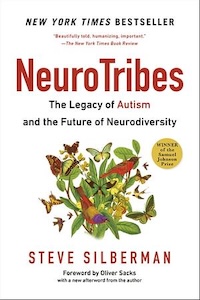
The cover of the book is white with the title in red near the top and the authors name at the bottom. There is a cluster of plants near the bottom center of the page with butterflies and few birds within the plants.

Author’s Website
Steve Silberman (Wikipedia)
Publisher / Date
Harvest Publications, August 2021
Genre
Essay Collection
Page Count
400
Completion Date
April 28, 2025

Recent statements by both Dr. Oz and RFK, Jr. should be viewed with alarm

“It is your patriotic duty, I’ll say it again, the patriotic duty of all Americans to take care of themselves because it is important for serving in the military, but it is also important because healthy people don’t consume health care resources,” Dr Oz during his swearing in a ceremony at the White House in April 2025

“Autism destroys families, and more importantly, it destroys our greatest resource, which is our children,” […] “They’ll never pay taxes, they’ll never hold a job, they’ll never play baseball, they’ll never write a poem, they’ll never go out on a date. Many of them will never use a toilet unassisted.” RFK Jr. an HHS press conference in Washington, D.C. on April 16th.

These are dangerous words, and it doesn’t matter if it seems like they are talking about specific groups of people who are disabled or unhealthy. When you start down that path you end up with anyone who doesn’t fit a narrow definition of “normal” being excluded from society. We cannot allow this rhetoric to be believed and accepted. All lives are worthy no matter what they can or cannot do. The ability to work and / or pay taxes should not be a determining factor of who is worth keeping.

Their rhetoric around disability and illness has strong elements of eugenics. Both highlight the idea that people who are disabled and/or unhealthy, and are unable to work are harmful to society. Their attitude seems to be that people who are ill and/or disabled cost too much money and if we weren’t around spending money everything would be fine. They also seem to be big on the idea of “personal responsibility” in a way that implies that any illness or disability is the fault of the person who has it rather than something that happens. They are suggesting that if we ate better food and exercises we would never get sick or ill and our children would never be disabled. All of this is untrue and harmful to those of us with disabilities and/or chronic illness.

Additional Reading

Disability, Eugenics, and the Value of Human Life” by Talia Lavin at The Sward and the Sandwich

RFK Wants to Send People to ‘Wellness Farms.’ The US Already Tried That” by Kathryn Waring at Teen Voque

All Autistic People Have Value, Something RFK Jr. and Profound Autism Parents Refuse to Understand” by Shannon Des Roches Rosa at Thinking Persons Guide to Autism

“We’re Not Broken” Review

“We’re Not Broken: Changing the Autism Conversation” by Eric Garcia

Garcia began writing about autism because he was frustrated by the media’s coverage of it; the myths that the disorder is caused by vaccines, the narrow portrayals of autistic people as white men working in Silicon Valley. His own life as an autistic person didn’t look anything like that. He is Latino, a graduate of the University of North Carolina, and works as a journalist covering politics in Washington D.C. Garcia realized he needed to put into writing what so many autistic people have been saying for years; autism is a part of their identity, they don’t need to be fixed.

In We’re Not Broken, Garcia uses his own life as a springboard to discuss the social and policy gaps that exist in supporting those on the spectrum. From education to healthcare, he explores how autistic people wrestle with systems that were not built with them in mind. At the same time, he shares the experiences of all types of autistic people, from those with higher support needs, to autistic people of color, to those in the LGBTQ community. In doing so, Garcia gives his community a platform to articulate their own needs, rather than having others speak for them, which has been the standard for far too long.

Review

I originally read this back in 2022 sometime after it came out in 2021 and wanted to re-read it now both to do a review for it and also because of the current political rhetoric around autism. I really like the way Eric Garcia took the time to explain why and how he wanted to write this book. There was a good variety of people represented in this book from across the spectrum of support needs as well as gender and race.

Garcia also makes a point of saying how people can have different needs but often assumptions are made about who needs what supports to be successful. He emphasizes that Autistic individuals who succeed don’t “overcome” their autism but rather succeed because they are given the proper supports throughout their lives. There was a lot of discussion about being willing to seek out support along with the fear that needing support means one is not capable of being out in the world which can hinder actually getting support.

The book is divided into several categories including those for work, education, housing, gender, and race and in each one Garcia both tells his own experiences and also shares the experiences of others. Again, each section does a good job of showing a range of experiences. I particularly appreciated the first chapter which outlined a lot of the history of autism and how it has been viewed over the years. It’s a bit weird reading this book now during the second Trump presidency when it was written during the first and some policy decisions were made at that time.

I also appreciated the gender and race sections of the book, which illustrated why there is seemingly such an increase in diagnosis over the years. Girls, non-binary, and trans individuals are often overlooked as many traits are assumed to be more about gender (like being shy) than anything else. Also, with regard to race, there was a point in time when it was assumed only white boys were autistic (mostly due to the way studies were conducted), while Black and Brown children were given different diagnoses, such as Oppositional Defiant Disorder.

Overall, I think Garcia does a great job highlighting the various issues that autistic people face and the ways that assumptions have been made across the spectrum with regard to ability and how best to support autistic people. There is some good discussion about the conflicts that can exist between parent advocates and self-advocates. Nearly always, parents want to do best by their children, but sometimes the idea of finding a cure can cause more harm than good. Often, the push for a cure comes at the expense of actually providing care and support to the children and adults that currently exist. And this is true for a lot of different disabilities where better supports would be appreciated more than finding a cure.

Book Details

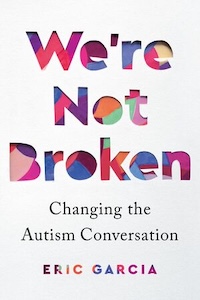
The book cover is a sold white background with the title written one word per line down the center. The letters of the title are colored in different colored sections: orange, pink, purple, green, blu and red. The subtitle is under the main title in solid black and then the authors name is at the bottom with the same color patterns.

Author’s Website
Eric Garcia
Publisher / Date
Harvest Publications, August 2021
Genre
Essay Collection
Page Count
304
Completion Date
April 21, 2025

“Warped State” Review

“Warped State” (“The Gifted of Brennex” No. 1) by Jo Miles

Jasper Wilder is an activist, not a spy, but he’ll become one if that’s what it takes to stop Ravel Corporation from reviving the research project that devastated his home planet.

His plan is simple enough: Break into the secure facility. Steal the research data. Find a weakness and sabotage the project. But all that goes out the airlock when he meets Havoc, a passionate but politically naive labor organizer trying to reform Ravel from within.

Havoc could help Jasper, but instead, he’s fighting for a lost cause. Jasper knows that if he sticks with his own plan, Havoc will likely take the blame—and Ravel doesn’t treat activists kindly.

With an elite security operative closing in, and time running out to sabotage the deadly project before it launches, Jasper needs to find a way to team up with Havoc… before his mission hurts the person he’s coming to care about.

Review

I really enjoyed reading this book. The characters were interesting and I had fun getting to know them. I also liked the way various methods of advocating for change were explained and discussed in the book. It was interesting seeing how the main characters, Jasper and Sowing of Small Havoc were dealing with the various issues. I thought it worked out well to explore why Havoc was so loyal to the company (Kovari cultural reasons) and that there were others who felt differently among his people but it took work for him understand it. I also liked that while Jasper had ideas about how to do things he was willing to work with Havoc later on to resolve everything.

I liked the way the friendship developed between Jasper and Havoc and I was okay with the potential romantic relationship developing because it came later on in the plot and didn’t distract from what was gone on. The main villein was a bit ridiculous but given how certain people in the current administration are reacting to criticism it clearly isn’t as far fetched as you’d think.

One somewhat frustrating part was the existence of a villain character who had augmented legs while also being addicted to pain killers. The addiction only seemed to exist as a method to allow the ship he was using (which has at some point become sentient) to help Havoc and Jasper with their work as the character was unconscious at the time. Nothing is ever mentioned about it again after that.

I did like that there were other people on the planet that were working to free themselves from Rival’s occupation and that it was a mix of both Human and Kovari – seemingly with Kovari in charge of that group. I also liked that there was at least one disabled character (a wheelchair user) in that group to balance out the evil disabled character.

I’m interested in reading the next book in the series though and seeing more of this universe.

Additional reviews and warnings can be found on the StoryGraph page for “Warped State”

Book Details

The cover is blue with what looks like an industrial land scape at the bottom of the cover. With a star filled sky above it. In the background there is the black profile of a head over the sky looking towards the right. There is another planet with a moon orbiting it at the top right corner and a space ship flying up and to the left with a trail of yellow, white light coming from the bottom.

Author’s Website
Jo Miles
Publisher / Date
Self Published, September 2023
Genre
Science Fiction
Page Count
398
Completion Date
April 12, 2025

“The Way of Thorn & Thunder” Review

“The Way of Thorn & Thunder Trilogy: The Kynship Chronicles” by Daniel Heath Justice

Originally Published by Kegedonce Press between 2005 and 2007 as three books “Kynship”, “Wyrwood”, and “Dreyd”. The revised and expanded 2011 reissue from the University of New Mexico Press is an omnibus volume: one novel now divided into seven cycles.

The Everland-home of the tree-born Kyn since time immemorial, a deep green world of ancient mystery and danger. The wyr-powers of the Kyn and the other Eld Folk have preserved this wild region from the ravenous hunger of Humanity for over a thousand years, but those powers are fast fading away. As the eyes of Men turn once more to the Everland and its rich bounty, the leaders of the Folk gather in Sheynadwiin, the Kyn capital, hoping to find a way to survive the growing storm.

She is Tarsadeshae the Spearbreaker a fearless Kyn warrior trained in the Redthorn ways of battle and blood. She knows her place in the Everland’s cycle of life and death, and that knowledge gives her strength and purpose. Yet Tarsa’s ordered world is shattered when an act of courage goes horribly awry, and her spirit awakens to the wild wyr of her ancestors powers long persecuted by the assimilationist Shields and their allies. As she struggles to reconcile her former life with the call of the rising bloodsong, Tarsa joins the summons of the Sevenfold Council, where she is swept into the struggle between those Folk who would embrace the promises of Men, and those who would hold fast to the rooted understandings of the Eld Green. For all who call the Everland home, there can be no middle path.

Review

This is a really interesting and complex book. I read the original three novels years ago and have always wanted to read it again. The story itself is an alternate version of Europeans colonizing the “new world”. Only in this case a fantasy version of humans with magical powers caused a catastrophic merging of two worlds a thousand years ago – the world of Men and the world of Eld Folk. And of course Men want to have everything and don’t care what the Eld Folk want.

There is a lot going in this novel and while it does take some time to get through, I feel like it’s ultimately worth it. The writing is very detailed and mostly narration, while also having many different characters and points of views with individual stories happening around the central story. If you’ve read “Lord of the Rings” you’ll get a sense of what the writing is like. I really enjoyed getting to know all of the different characters and learning their stories. I did like the ending of the book and the hopeful feel of it despite everything that had happened.

You may be interested in reading Bogi Takács’s reviews of the novel (in three parts):
The Way of Thorn and Thunder by Daniel Heath Justice (Part 1)
The Way of Thorn and Thunder by Daniel Heath Justice (Part 2)
The Way of Thorn and Thunder by Daniel Heath Justice (Part 3)

Additional reviews and warnings can be found on the StoryGraph page for “The Way of Thorn & Thunder”

Book Details

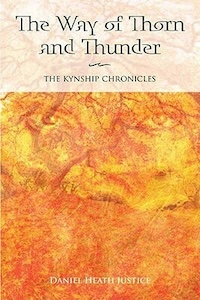
The book cover is fulled with orange and red and yellow flames covering the vague image of ground and a tree with one or two faces in the center of the image - two eyes are visible but it looks like there might be two faces half on top of each other in the middle of it. The title of the book is on the top with a white transparent background over the tree  and the authors name is at the bottom.

Author’s Website
Daniel Heath Justice
Publisher / Date
University of New Mexico Press, 2011
Genre
Fantasy
Page Count
616
Completion Date
April 5, 2025

“The Final Strife” Review

“The Final Strife (The Ending Fire Trilogy No. 1)” by Saara El-Arifi

The Empire rules by blood

Red is the blood of the elite, of magic, of control.

Blue is the blood of the poor, of workers, of the resistance.

Clear is the blood of the servants, of the crushed, of the invisible.

The Aktibar – a set of trials held every ten years to find the next Ember rulers of the Empire – is about to begin.

All can join but not just anyone can win; it requires great skill and ingenuity to become the future wardens of Strength, Knowledge, Truth and Duty.

Sylah was destined to win the trials and be crowned Warden of Strength. Stolen by blue-blooded rebels she was raised with a Duster’s heart; forged as a weapon to bring down from within the red-blooded Embers’ regime of cruelty. But when her adopted family were brutally murdered those dreams of a better future turned to dust.

However, the flame of hope may yet be rekindled because Sylah wasn’t made to sparkle, she was born to burn.

Review

I really enjoyed this book. The characters were really interesting and I enjoyed getting to know them. The word building was great – I really liked how everything started to come together as the story progressed and the characters learned more. There were a lot of twists and turns in this book and not everything was as it seemed. I liked the way the different relationships grew and developed during the course of the book. Though it doesn’t end on a cliffhanger it does set up the threads of the next book, which I’m looking forward to reading soon.

Warnings and additional reviews are available on the StoryGraph page for “The Final Strife”.

Book Details

The cover is taken up by a white laced pattern that has a red strip through the bottom half and red cen also be seen through the lace. The title is written near the top with the authors name at the bottom

Author’s Website
Saara El-Arifi
Publisher / Date
HarperVoyager, June 2022
Genre
Fantasy
Page Count
478 pages
Completion Date
March 30, 2025

“Compound Fracture” Review

“Compound Fracture” by Andrew Joseph White

On the night Miles Abernathy—sixteen-year-old socialist and proud West Virginian—comes out as trans to his parents, he sneaks off to a party, carrying evidence that may finally turn the tide of the blood feud plaguing Twist Creek: Photos that prove the county’s Sheriff Davies was responsible for the so-called “accident” that injured his dad, killed others, and crushed their grassroots efforts to unseat him.

The feud began a hundred years ago when Miles’s great-great-grandfather, Saint Abernathy, incited a miners’ rebellion that ended with a public execution at the hands of law enforcement. Now, Miles becomes the feud’s latest victim as the sheriff’s son and his friends sniff out the evidence, follow him through the woods, and beat him nearly to death.

In the hospital, the ghost of a soot-covered man hovers over Miles’s bedside while Sheriff Davies threatens Miles into silence. But when Miles accidentally kills one of the boys who hurt him, he learns of other folks in Twist Creek who want out from under the sheriff’s heel. To free their families from this cycle of cruelty, they’re willing to put everything on the line—is Miles

Review

Another great book by Andrew Joseph White! Since it set in modern times (shortly after President Trump’s first election) without a large fantasy element it’s a little different than his other books. Some of the plot seemed a bit far fetched on how things would go down. However the setting is small town Appalachia so maybe it works more than I think it would. I really enjoyed reading Miles’ story and finding more about what had happened to the family and who the ghost that appears to Miles ends up being. Nothing is ever as simple as it seems. I really liked the way in this story Miles actually had a family that cared about him and other community members who were supportive against the threat of the Sheriff. I really liked the ending of the book as well and the hopefulness of what could come next for the town.

Warnings and additional reviews are available on the StoryGraph page for “Compound Fracture”

Book Details

The book cover depicts a young man in the center of the cover with short hair wearing a yellow sleeveless shirt and a rad bandana around their neck. Their eye is bleeding and he has his hand up over it. There is a dog at his side looking like it's frowning at something to the right. Behind the man are trees and the image is framed by antlers around the top and sides. At the bottom is a barbwire fence with a banner held by railroad spikes and the title is on the banner. The authors name is at the top also written on a banner that is held across the top on two of the antlers

Author’s Website
Andrew Joseph White
Publisher / Date
Peachtree Teen, September 2024
Genre
Young Adult, Thriller
Page Count
371
Completion Date
March 21, 2025

“Disposable” Review

“Disposable: America’s Contempt for the Underclass” by Sarah Jones

In the tradition of Matthew Desmond’s Evicted and Andrea Elliot’s Invisible Child, Disposable is a poignant exploration of America’s underclass, left vulnerable by systemic racism and capitalism. Here, Sarah Jones delves into the lives of the essential workers, seniors, and people with disabilities who were disproportionately affected by COVID-19—not due to their age or profession, but because of the systemic inequality and poverty that left them exposed.

The pandemic served as a stark revelation of the true state of America, a country where the dream of prosperity is a distant mirage for millions. Jones argues that the pandemic didn’t create these dynamics, but rather revealed the existing social mobility issues and wealth gap that have long plagued the nation. Behind the staggering death toll are stories of lives lost, injustices suffered, and institutions that failed to protect their people.

Jones brings these stories to the forefront, transforming the abstract concept of the pandemic into a deeply personal and political phenomenon. She argues that America has abandoned a sacrificial underclass of millions but insists that another future is possible. By addressing the pervasive issues of racial justice and public policy, Jones calls for a future where no one is seen as disposable again.

Review

This was a really good look at the various issues around COVID disparities and the vastly different outcomes because of race, disability and/or poverty. I felt like the author did a great job using various peoples’ stories to showcase all the different situations and outcomes. I also liked that the author discussed the issues with congregate settings and how people in those settings were basically doomed by COVID. There was a good focus on all kinds of congregate settings from people with Intellectual Disabilities in group homes, to elderly individuals in nursing homes to individuals in prisons and jails. There was also a good discussion about the way various jobs didn’t allow for any precautions to be taken and people were forced to work while sick or risk being fired because there’s no paid sick time for many.

There’s also the emphasis on how if you don’t have money or status and can’t work you’re not seeing as worthy. The rich and powerful only care about money and staying in power. The way things opened back up quickly just highlighted how much people cared more about the economy than people. I also liked the fact that the author didn’t shy away from saying that COVID is still a major problem and that people are still getting sick and dying from it. We never should have tried to return to normal because normal doesn’t exist anymore.

Book Details

The cover of Disposable has a black and white image of an empty country road with light posts and trees on the side and wires going across. There is an American flag floating in the air upside down and partially folded over under a dark cloudy sky. The title is at the top with the authors name at the bottom.

Author’s Website
Sarah Jones (Blue Sky)
Publisher / Date
Avid Reader Press / Simon & Schuster, February 2025
Genre
Essay Collection, Disability, COVID
Page Count
295
Completion Date
March 16, 2025

“The Future Is Disabled” Review

“The Future Is Disabled: Prophecies, Love Notes and Mourning Songs”
by Leah Lakshmi Piepzna-Samarasinha

In The Future Is Disabled, Leah Laksmi Piepzna-Samarasinha asks some provocative questions: What if, in the near future, the majority of people will be disabled – and what if that’s not a bad thing? And what if disability justice and disabled wisdom are crucial to creating a future in which it’s possible to survive fascism, climate change, and pandemics and to bring about liberation?

Building on the work of their game-changing book “Care Work: Dreaming Disability Justice”, Piepzna-Samarasinha writes about disability justice at the end of the world, documenting the many ways disabled people kept and are keeping each other – and the rest of the world – alive during Trump, fascism and the COVID-19 pandemic. Other subjects include crip interdependence, care and mutual aid in real life, disabled community building, and disabled art practice as survival and joy.

Written over the course of two years of disabled isolation during the pandemic, this is a book of love letters to other disabled QTBIPOC (and those concerned about disability justice, the care crisis, and surviving the apocalypse); honor songs for kin who are gone; recipes for survival; questions and real talk about care, organizing, disabled families, and kin networks and communities; and wild brown disabled femme joy in the face of death. With passion and power, The Future Is Disabled remembers our dead and insists on our future.

Review

The basic concept of this book is that we’d all be a lot better off if we learned how to care about each other and to take care of each other without getting caught up in our differences. Not that it’s ever easy – there’s a whole chapter on why even people with good intentions in the disability community doing disability justice work can cause harm to each other. But the basic fact remains if we worked together instead of fighting each other we be better off. The book was written during the first Trump presidency and the points made in the book matter even more now during the second.

It also makes the point that we often forget how vastly different our experiences can be. COVID impacted people very differently and while many people were stuck at home bored others were dealing with the deaths of friend and family on a near daily bases. COVID never actually ended and yet everyone wanted to go back to normal. Normal doesn’t exist and often disabled people are the first to learn how to adapt to a new world. Now is the time to learn.

Book Details

The book cover has a bright light at the top left corner which shines white, orange, red, purple to the bottom right where it's a darker blue/black. In the center of the cover is a sundial but the numbers are figures of people with a person standing in the center showing a shadow towards the bottom right corner.  The title is positioned at the bottom left corner with the authors name at the top.

Author’s Website
Leah Lakshmi Piepzna-Samarasinha
Publisher / Date
Arsenal Pulp Press, October 2022
Updated 2023 edition includes a new chapter and afterword by the author
Genre
Memoir, Essay Collection, Disability
Page Count
334
Completion Date
March 9, 2025

Existing As I Am

As someone who has spent their entire life proving the doubters wrong with regard to disability, I am not surprised at the way things are going. When you live in a world where a baby’s potential value is judged within days after birth, it’s not surprising that some people would rather we just disappeared (or died).

I was born in 1979 in Texas, of all places. Apparently I came out the blue and it took a lot of work to keep me alive the first night. At least one doctor told my parents that even if I lived I’d be blind, deaf and intellectually disabled. Thankfully there was another doctor who said I’d most likely be fine. There’s even a story that I kicked out the sides of the incubator I was in at one point. Here I am four and a half decades later, and while I’m hard of hearing, have a facial disfigurement and vision issues, there’s no sign of an intellectual disability. Not that it should have mattered. All lives are worthy – having an intellectual disability shouldn’t have meant I was better off dead or institutionalized either.

A large issue with having to prove doubters wrong is the way we have to constantly prove our worth. Things like excellent behavior, getting the best grades in school, going to college, graduating with distinction, getting a good job and doing our best at it, are all signs that it is worth keeping us alive. We’re proving our worth to a society that thinks we shouldn’t exist at all. We shouldn’t have to prove anything – a disabled person who doesn’t do well in school or a job and struggles with everything shouldn’t deemed less worthy than someone who is successful. You only have to take one look at media that glorifies successful disabled people and says things like, “they never let their disability stop them” to see the truth. In reality it almost never is our disabilities stopping us. It was the ableism of society making assumptions about our worth. 

It’s not surprising that society also judges people based on their relationships. We’re supposed to date, get married and have kids all for the betterment of society. And of course, we must find someone of the opposite gender to do all of this with. Any deviation from that norm is seen as abnormal and wrong. Unfortunately, there is an assumption that disabled people are exempt from this because we’re not worthy enough to date, get married or have kids. As a result, some disabled people may strive to prove that assumption wrong by doing exactly what is expected.

Those of us who are asexual and/or aromantic are often assumed to be that way because of our disabilities, which causes conflict in both groups. The truth is we are asexual and/or aromantic while also being disabled, and not because of it, and there shouldn’t be anything wrong with that. I’ve known for years I was asexual – I never had any interest in dating or anything. Aromantic was a word I learned more recently and also fit. There isn’t any particular reason why I am asexual and aromantic, I just am. 

Gender has always been something in the background for me, as being hard of hearing and dealing with that – and other issues – took up most of my focus. I had to navigate communication issues with everyone, almost all of the time. It’s not fun having to remind people that I am in fact hard of hearing, even with my hearing aids on. As a result I never really thought about it all that much, other than knowing I didn’t enjoy typical girl things. I didn’t like dolls or makeup or bright colors that girls are often expected to like. But it is also true that my parents never really made that much of a big deal about it. 

Within the last few years, I’ve really come to understand what being non-binary or agender means, and realized that it describes me. Agender probably fits best as I don’t really feel particularly drawn to any gender specifically. Having said that, I generally don’t mind female-gendered terms, with some exceptions. I don’t particularly like being called lady, as an example. On the flip side, I would much rather be called my parents’ daughter than child, because I’m an adult and the word “offspring” just sounds weird. But these are my own personal preferences – everyone else should be allowed to describe themselves on their own terms.
 
As I said at the beginning, I’m not surprised at the direction we’re going right now. And as I work out my gender and learn more about the trans/non-binary communities I see the same battles and the same struggle to be allowed to exist. I recently read the article “The fight against ableism mirrors the fight against transphobia” written by Ayman Eckford at PinkNews, which has a lot to say about what’s going on. Anyone who doesn’t fit the assumed norm is under attack right now by the current administration, and as always it’s about ableism: 

“Throughout history, ableism has been used against women to justify gender inequality, against Jewish people to justify the Holocaust, against people of colour to justify slavery and colonialism, and, of course, against the LGBTQ+ community.”

I am Jen Rohrig. I am hard of hearing, asexual, aromantic, agender and likely autistic. Proving the doubters wrong is the goal every day. Existing exactly as I am is the goal every day. I believe we all deserve to be able to be exactly who we are and exist as who we are, because we’re all human, with our various identities and differences.

Reading List

  • “Disability Visibility: First-Person Stories from the Twenty-First Century” edited by Alice Wong
  • “Being Seen: One Deafblind Woman’s Fight to End Ableism” by Elsa Sjunneson
  • “Black Disability Politics” by Sami Schalk
  • “The Future Is Disabled – Prophecies, Love Notes and Mourning Songs” by Leah Lakshmi Piepzna-Samarasinha
  • “Ace and Aro Journeys: A Guide to Embracing Your Asexual or Aromantic Identity” by The Ace and Aro Advocacy Project
  • “Gender: Your Guide: A Gender-Friendly Primer on What to Know, What to Say, and What to Do in the New Gender Culture” 2nd Edition by Lee Airton (make sure to get the 2024 edition)
  • “Ace: What Asexuality Reveals About Desire, Society, and the Meaning of Sex” by Angela Chen
  • “Refusing Compulsory Sexuality: A Black Asexual Lens on Our Sex-Obsessed Culture” by Sherronda J. Brown
  • “Ending the Pursuit: Asexuality, Aromanticism, and Agender Identity” by Michael Paramo